Author: Eddie

  • Can Underground Tanks Float? Could our Helical Piles Be a Simple Solution?

    This problem, known as tank flotation, can damage the tank, break underground piping, and lead to expensive repairs.

    So, how can we prevent it? And could helical piles offer a simpler solution?

    Why Do Underground Tanks Float?

    When groundwater rises around a buried tank, it creates an upward force called buoyancy.

    If that force is greater than the weight holding the tank down, the tank can begin to lift.

    This is more likely when:

    • Groundwater levels are high, especially during wet seasons.
    • Tanks are empty or partially empty, reducing their weight.
    • Lightweight tanks are used, such as polyethylene or fibreglass tanks.
    • The surrounding soil provides insufficient resistance to the upward force.

    Even heavy concrete tanks can be affected under certain conditions.

    How Is This Problem Usually Solved?

    Traditional solutions include adding concrete ballast, installing buried concrete anchor blocks, or using specially designed tank foundations.

    These methods can work well, but they may require additional excavation, heavy materials, lifting equipment and installation time.

    For projects with limited access or challenging ground conditions, a simpler anchoring method could be valuable.

    Could GoliathTech Helical Piles Be the Solution?

    Imagine securing an underground tank with four helical piles—two installed on each side of the excavation.

    The piles would be driven into suitable soil and connected to the tank using engineered straps or other approved restraints.

    Rather than relying on additional concrete weight, the piles would provide resistance against the upward force created by groundwater.

    The number of piles, their required tension capacity and the connections would be determined according to the project.

    Why Consider Helical Piles?

    1. Fast installation

    With suitable ground conditions and site access, a small group of helical piles can often be installed in a matter of hours.

    2. Immediate load capacity

    Unlike concrete foundations, helical piles don’t need curing time. Once properly installed and verified, the anchors can be ready to carry their designed loads the same day.

    3. Less concrete and excavation

    Helical anchoring could eliminate the need for additional concrete ballast or large buried anchor blocks, depending on the design.

    4. Compact installation equipment

    GoliathTech piles can be installed using relatively small equipment, making them worth considering on properties with restricted access.

    5. Measurable installation performance

    Installation torque provides valuable information for verifying pile capacity against the engineered requirements.

    6. Suitable for different tank types

    With appropriate engineering and manufacturer-approved restraints, this approach could be considered for concrete, fibreglass, polyethylene and other underground storage tanks.

    Could It Be More Cost-Effective?

    That’s worth exploring.

    Where conventional anchoring requires significant concrete ballast, additional excavation or heavy lifting equipment, helical piles may offer savings in installation time, material handling and site restoration.

    The advantage is having another practical option to consider.

    Let’s Explore the Possibilities

    At GoliathTech West GTA, we’re always looking for ways to make foundation and anchoring work simpler, faster and more efficient.

    If you’re a septic installer, excavation contractor, tank supplier or engineer working on underground tank installations, we’d be interested in discussing whether helical piles could provide an effective anchoring solution for your next project.

    We serve Burlington, Milton, Brampton, Oakville, Caledon, Collingwood, Georgian Bay, the Bruce Peninsula and surrounding areas.

    GoliathTech West GTA
    Phone: 742-778-7783
    Email: [email protected]
    Website: https://darkblue-clam-970668.hostingersite.com
  • Protecting Your Custom Home From the Ground Up

    Protecting Your Custom Home From the Ground Up

    For contractors and homeowners planning a custom build, it is a question worth asking before the concrete is poured.

    A custom home represents years of planning, saving, and hard work. Every finish, every room, and every detail depends on the foundation beneath it. Yet one of the most valuable investments in that home may be something you will never see: helical piles integrated into its reinforced concrete foundation.

    The problem: concrete depends on the ground beneath it

    A concrete foundation carries the weight of the home and transfers it to the soil. But soil conditions can vary across a building site, and some soils expand or shrink as moisture levels change. U.S. Geological Survey

    If the ground beneath one section provides less support than another, the foundation can settle unevenly. That movement can lead to cracked walls, sloping floors, and doors or windows that no longer close properly.

    For homeowners, the consequences can extend beyond the foundation itself. Repairs may involve excavation, structural work, waterproofing, and restoration of damaged finishes or landscaping. Major projects can exceed $100,000, depending on their scope.

    For contractors, a settlement problem can mean callbacks, difficult conversations, and a reputation put under pressure long after the home is completed.

    The time to address ground-support risk is while the foundation is being designed.

    The solution: deeper support connected to the concrete

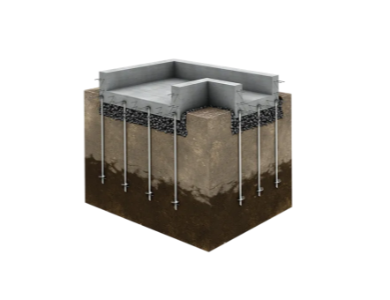
    GoliathTech helical piles can form part of an engineered system supporting a new concrete foundation.

    The piles are installed through weaker upper soil to deeper material capable of providing the required bearing support. Extensions allow installation to continue where greater depth is necessary. GoliathTech’s process includes assessing site conditions and monitoring installation resistance using calibrated torque-reading equipment. GoliathTech home foundation brochure

    At the top of each pile, a structural head with rebar connects the pile to the concrete foundation. These heads are incorporated into the foundation reinforcement before the concrete is poured.

    The finished system creates a path for the building’s weight:

    How does this help prevent settlement?

    The piles provide support below the shallow soil layers that might otherwise allow the foundation to settle.

    Meanwhile, the concrete and reinforcing steel are engineered to distribute the building’s loads between pile locations. The embedded pile heads connect those supports to the foundation.

    Together, they create a foundation system designed to remain supported even if weaker near-surface soil loses bearing support. Check out our GoliathTech concrete applications brochure.

    The design matters. Pile diameter, helix size, depth, spacing, connections, and concrete reinforcement must suit the home and its soil conditions. The objective is to control settlement within engineered limits; concrete shrinkage and other causes of cracking still require appropriate design and construction.

    What could that investment look like?

    Consider a $1 million custom-home build with a 40-by-50-foot footprint.

    That footprint has 180 linear feet of exterior foundation perimeter. An illustrative layout with piles at every corner and no more than eight feet between supports would contain 24 piles.

    The comparison makes the decision tangible:

    A hidden gem beneath your home

    You see the kitchen every day. You notice the flooring, windows, and craftsmanship.

    The pile system disappears beneath the finished home—but its purpose remains: supporting the foundation and helping protect everything above it.

    For homeowners, it is an investment in confidence and reduced settlement risk. For contractors, it is a way to build quality into a part of the home customers rarely see but always depend on.

    GoliathTech’s hidden gem is the ability to connect deeper ground support directly to your concrete foundation from the start.

    Before your next custom-home foundation is poured, speak with your local GoliathTech certified installer and engineer about a pile-supported design.

  • What Are Helical Piles? A Simple Guide for Homeowners

    Helical piles are one foundation option worth understanding. Here’s a simple introduction to how they work and what to consider for your project.

    What is a helical pile?

    Specialized equipment turns the pile into the ground, a little like turning a screw into wood. The helix transfers the weight of your structure into the soil. A bracket or plate at the top connects the pile to the structure above.

    What can piles support?

    Helical piles can support decks, gazebos, sheds, additions, and other structures. The pile size, connections, and layout need to suit the project—there isn’t one pile that fits every job.

    Why do homeowners choose them?

    For many backyard projects, the appeal is straightforward:

    • Less digging: Installation generally avoids the large holes needed for poured concrete footings.
    • No concrete curing time: Once installation is complete and any required inspections are cleared, construction can move ahead.
    • Compact equipment: This can make installation practical where backyard access is limited.

    We still need to check access and ground conditions. Compact equipment helps, but every property is different.

    How deep do they go?

    The right depth depends on the soil, frost requirements, and the load the pile needs to support. Some locations require deeper installation than others.

    Extensions can be added when more depth is needed. That’s why it’s helpful to understand how additional depth will be handled in your quote before installation starts.

    How do we know a pile can support the weight?

    Depth and torque both matter. The installation needs to meet the requirements for your project.

    What should you have ready?

    A few details help us give you useful advice:

    What you’re building and its approximate size.

    Your project address.

    A few photos showing the installation area and access.

    Any drawings or required loads you already have.

    Underground utilities also need to be located before installation. Privately owned lines, such as power to a shed or gas to a barbecue, may need separate private locates.

    Have a project in mind? Let’s talk.

    If you need help with engineering, we can assist with that too.

    Whether you’re planning a small gazebo or a larger project, we’re happy to help you get started.

    Eddie and the GoliathTech West GTA team